






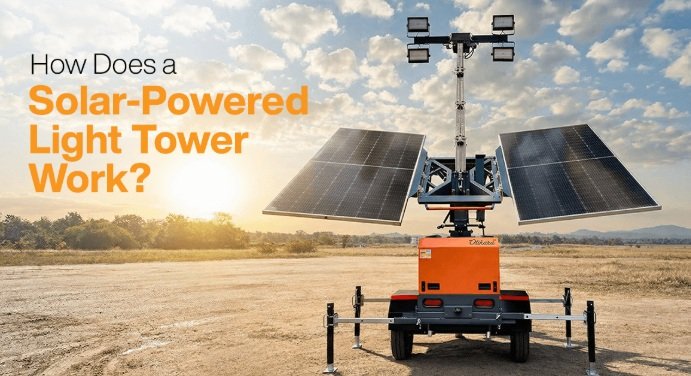
The Solar-Powered Light Tower has become a potent alternative to conventional diesel-powered lighting systems as industries shift towards cleaner and smarter energy solutions. These towers are extensively used in construction sites, mining, roadwork, events, and emergency response areas to provide effective lighting without increasing fuel dependence, emissions, and operational expenses.
A Solar Light Tower has been designed to be both high-performance and long-lasting, with the ability to produce renewable energy and store more energy with a high-capacity battery and LED lighting. This combined design guarantees reliable lighting in remote or off-grid areas, as well as operational effectiveness and compliance with current environmental and regulatory standards.
Let’s see how a solar light tower actually works.
What is a Solar Light Tower?
A Solar Light Tower is a portable lighting solution that uses solar panels to store solar energy in batteries, which then light up LED luminaires with high levels of efficiency. It is also silent as compared to the diesel light towers, causes no emissions when it is used, and needs low maintenance.
Solar-powered towers are commonly trailer-mounted, portable, and capable of performing numerous nights of independent operation, even when the sun is low.
Core Components of a Solar-Powered Light Tower
To know how a solar light tower works, it is essential to start with the basic components of a tower, which are essential to provide uninterrupted lighting.
1. Solar Panels – Energy Harvesting Unit
The photovoltaic (PV) panels are super high-efficiency panels that absorb sunlight and transform it into direct current (DC) electricity.
Recent designs employ tilt-adjustable panels to maximize the exposure during the day; this technique is widely used in more developed towers manufactured in India, and used at highways and other infrastructure jobs.
Key function:
- Transforms sunlight into useful electrical energy
- Charges the battery bank in daytime
2. Charge Controller – The Energy Regulator
The charge controller also regulates the circulation of electricity between the batteries and the solar panels. It eliminates overcharging, deep discharging, and voltage changes, hence prolonging the battery life and keeping the systems stable.
In high-performance solar light tower systems, advanced MPPT (Maximum Power Point Tracking) controllers are being applied to maximize the output even when clouds are present.
Key function:
- Maximizes the use of solar power
- Shields batteries from destruction
3. Battery Bank – Power Storage System
Power generated in the day is stored in deep-cycle batteries (lithium-ion or tubular lead-acid). These batteries are used to power the tower during the night or when the sun is low.
Many solar light towers today are designed to provide 8-12 hours of continuous illumination after a single, charge-up making them useful in overnight construction or mining.
Key function:
- Stores solar energy
- Allows nighttime and backup operation
4. LED Luminaires – High-Efficiency Lighting
LED lights are the heart of illumination. LEDs use much less power and have greater lumens per watt than metal halide lamps.
Industry-grade solar towers are generally fitted with multi-directional LED fixtures mounted on telescopic masts, which cover wide areas and produce minimal glare, ideal in roadwork areas and on large-scale projects.
Key function:
- Offers bright, uniform illumination
- Reduces power consumption
5. Telescopic Mast & Mobility System
The mast also enables lights to be lifted to 6-9 meters, high which guarantees extensive light scattering. Towers are fitted onto rough trailers that use outriggers to stabilize them and are therefore easy to move in distant or rugged locations.
This design is commonly observed in solar towers supplied for mining belts and rural infrastructure developments in India.
Key function:
- Increases lighting to achieve maximum coverage.
- Allows easy transport and setup
Step-by-Step: How a Solar Light Tower Works
Here’s a simplified operational flow of a Solar-Powered Light Tower:
- Daytime Charging
Solar panels absorb sunlight and transform it into electricity.
- Energy Regulation
The charge controller manages and directs power to the batteries.
- Energy Storage
The energy generated is stored in batteries to be used later.
- Automatic Activation
The LED lights are automatically turned on by a light sensor or timer when it gets dark.
- Nighttime Illumination
The LED luminaires are powered by stored battery power during the night.
- Repeat Cycle
The system automatically recharges on the next day.
Real-World Applications of Solar Light Towers
Solar light towers are changing various sectors across India and the world:
- Construction & Infrastructure: Night concreting, highway expansion, metro work
- Mining & Industrial Sites: Safe, uninterrupted lighting in remote areas
- Events & Temporary Venues: Silent, eco-friendly illumination
- Disaster Relief & Emergency Response: Quick deployment without fuel reliance
A number of high-capacity solar tower designs that are now working in these sectors demonstrate high battery autonomy and rugged design elements – attributes now regarded as industry standards by major Solar Light Tower manufacturers.
Advantages Over Diesel Light Towers
The fact that Solar-Powered Light Towers have a definite advantage over the traditional diesel-powered ones is one of the strongest arguments in favor of their recent increased popularity. In fact, its market is growing at a rate of 4.79% in the 2026-2034 period. Compared with diesel towers, solar solutions perform better on several fronts as far as both operational efficiency and environmental responsibility are concerned.
1. Fuel Cost Elimination & Energy Independence
Firstly, one of the greatest advantages is fuel cost elimination. Solar towers do not need any external energy source since the towers use solar energy that is always renewable, eliminating the current costs and logistical difficulties of sourcing, storing, and fueling diesel.
2. Zero Emissions & Environmental Sustainability
Secondly, solar light towers are more environmentally superior. In comparison with diesel-powered towers, which release carbon dioxide, nitrogen oxides, and particulate matter, solar-powered systems do not produce emissions at all.
This is why they are a perfect solution for organizations that want to achieve sustainability goals and adhere to strict environmental standards.
3. Silent Operation & Improved Site Comfort
One more essential benefit is that it operates silently. Diesel generators are known to produce continuous noise which can disturb residential neighborhoods, nighttime construction works, and event setting.
The solar light towers are quiet, which enhances comfort and acceptance by the people.
4. Low Maintenance & Reduced Downtime
Solar towers need very little maintenance in terms of upkeep. Diesel engines require regular servicing, oil replacement, filter change, and mechanical check-ups.
Solar-powered systems require less maintenance effort and less downtime and increase service life since they have fewer moving components.
5. Lower Total Cost of Ownership
Lastly, solar light towers are much more economical as far as the overall cost of ownership is concerned. Solar-powered light towers are more economically prudent in the long run since their upfront cost might be similar to or slightly more than that of the first generation.
A solar light tower is cheaper in the long run since no fuel is needed and its lifespan is longer compared with the initial cost. All these benefits make solar light towers a future-friendly, economical, and environmentally friendly substitute for diesel lighting systems.
Conclusion
A Solar-Powered Light Tower smartly gathers solar power, stores efficiently, and transforms it into bright, dependable lighting, without using fuel, noise, or emissions. Solar panels and batteries to LED luminaires and smart controllers, every element is critical in the development of a self-sustaining lighting system.
Olikara Lighting Towers is one of the sophisticated solar light tower suppliers in the market today, and their towers are a perfect combination of Indian engineering and solar innovation, which provides reliable, high-performance solar-powered light towers in various applications.
FAQs
1. What is the run time of a solar light tower on a full charge?
The majority of solar light towers can be left to work 8-12 hours a day, depending on battery capacity and LED load.
2. Are solar light towers effective during cloudy or rainy seasons?
Yes. The charged batteries allow the device to operate in low-sunlight or cloudy periods.
3. Are solar light towers appropriate in remote areas?
Absolutely. They can be used in off-grid and remote locations since they do not need fuel and power.
4. What is the maintenance of a solar light tower?
Very low. Primarily periodic panel cleaning and basic battery health checks.
Refresh Date: January 31, 2026