







Introduction
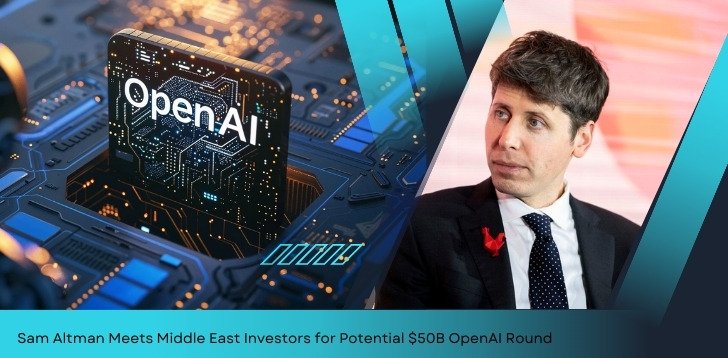
The AI funding competition has become entirely madder. Sam Altman is already sitting with Middle East investors to raise what would be the largest tech capital raise in history – a potential five hundred billion dollars to OpenAI that would value the company at between 750 billion and 830 billion.
Yeah, you read that right. We are discussing figures that used to appear unattainable only several years ago. It is not the first time that I am following the development of OpenAI, and I must admit that this most recent move has been causing my head to spin a bit.
The last destination that Altman has landed in is the United Arab Emirates, where he is having a serious chat with government-supported investment funds in Abu Dhabi. This is only a few weeks following the record-breaking investment of SoftBank, which invested in the company at 40 billion dollars. It seems like it was not enough.
It is still in the initial phases of the negotiations, and no contracts have been agreed upon. However, in case this deal occurs, it will change the landscape of AI investing and is likely to establish OpenAI as the unquestioned leader in the field of artificial intelligence advancement.
Why OpenAI Requires another Megafunding Round
The AI Development Money Pit
That is the tip with developing state-of-the-art AI – it consumes money more rapidly than you could even imagine. The cost of the infrastructure of OpenAI is out of this world. Billions of dollars are being spent on Nvidia, AMD, and Broadcom chips. Next comes the data centres, the energy expenses,s and the talent.
OpenAI has already spent over 1.4 trillion in infrastructure investments within the next few years. That’s not a typo. Trillion with a T. The company is developing a vast network with such projects as Starg, which is estimated to cost approximately $500 billion alone.
OpenAI is yet to make a profit, even after all this expenditure. The rate at which the company is consuming money, as CFO Sarah Friar termed as unsustainable. She has publicly stated that compute is the most valuable asset in AI, and demand continues to increase.
Competition Is Heating Up
OpenAI will never be able to sleep on its ChatGPT laurels again. The Gemini of Google is improving. Claude is in earnest negotiations with Anthropic (with the support of Amazon). Elon Musk has an xAI that has just raised $6 billion and is constructing its own infrastructure.
All these competitors are shelling out billions of dollars in an attempt to match or even overtake. To ensure that OpenAI stays ahead, it must have the resources to continue innovating at a rate higher than all others.
Moreover, the company is allegedly planning to have an IPO, potentially in 2027. Funding rounds as large as this one contribute to the setting of the valuation expectations of that future public offering.
Who is playing in these Middle East Conversations?
Abu Dhabi’s Growing Role in AI
The UAE has transformed into a significant force in terms of AI investment, and it is not by chance. These state-owned coffers are deep-pocketed and long-term oriented, which fits well in the timeline of AI development.
The most common name will be MGX. This Abu Dhabi tech investment company, launched in March 2024 by Mubadala and AI company G42, has already invested massively in OpenAI. MGX was a part of the secondary sale of OpenAI in October 2025 that was valued at half a trillion, as well as the previous October 2024 round that was priced at 157 billion.
Altman has addressed Sheikh Tahnoon bin Zayed Al Nahyan as a dear personal friend publicly on social media, the chairman of MGX. Such a personal relationship is important in such mega-deals.
The Public Investment Fund (PIF) of Saudi Arabia is likely to be included as well. With assets under management worth more than $900 billion, PIF is considering AI as part of Saudi Vision 2030 – their strategy to no longer rely on oil.
The Middle East Makes Sense
These Gulf investors do not come with money alone. They offer:
- Flexibility in regulation – The UAE has a flexible regulation environment compared to most of the Western countries.
- Energy infrastructure – AI data centers are massive and need large amounts of electricity,y and the Gulf region possesses the power capacity and the desire to create additional capacity.
- Strategic alliances – OpenAI already has a large data center in the UAE, and stronger investment relations will make operational sense.
- Long-term capital – Sovereign wealth funds have the option of making investments in 10, 20, and even 30-year horizons, and this is ideal when it comes to AI development.
Comparison with Past OpenAI Funding
An Overview of the OpenAI History of Valuation
We might place this $50 billion potential round in perspective:
- October 2024: OpenAI was valued at 157 billion and raised more funds.
- March 2025: SoftBank was a lead in a 40 billion-round at a 300 billion post-money valuation.
- October 2025: The company was estimated at $500 billion in a secondary sale.
- December 2025: SoftBank was able to finish its entire investment of $40 billion.
- January 2026: Now trying to get $50 billion with a valuation of 750-830 billion.
That is over 5 times valuation growth over 15 months. Pretty wild, right?
The SoftBank transaction was already the largest inthe history of private tech financing, almost three times more than the prior record of Ant Group at 14 billion. This Middle East round would put that out of the water.
What Changed So Quickly
There were a couple of reasons that fueled this valuation explosion:
- The insane user growth of ChatGPT – The company has increased its weekly usersfromg 400 to 500 million in only one month. Altman has posted that they have recently added a million users in one hour.
- Revenue forecasts – OpenAI predicts that its revenue will increase to triple the previous value, reaching 12.7 billion by the year 2026.
- Infrastructure commitments – The Stargate project and other mega data center constructions will need capital on a scale that most companies would not even have dreamt of.
- Competitive positioning – Given the competition in the AI race, having the most funding is an overwhelming competitive advantage.
The Implications of this for the AI Industry
The Rich Get Richer
It is essentially a token of the AI market, which is coming together around a small number of capitalized companies, should this funding round occur. You can never compete in this space without tens of billions of dollars.
It is almost impossible to keep pace with smaller AI startups and research laboratories. Designing state-of-the-art AI designs is currently costing over a billion dollars per project. And that is not yet deployment and scaling.
Probably we are going to have further consolidation in the form of acquisition, strategic alliance,s or companies simply surrendering by failing to raise sufficient capital to compete.
Middle East Tech Influence
This is also an indicator of a huge change in the origin of tech capital. Silicon Valley once made itself the unchallenged hub of technology investment. Now? Gulf sovereign wealth funds are turning kingmakers.
Neither are they passive investors. These amounts desire control over strategic choices, access to technology,y and most likely control over the development of AI in the world. That raises some interesting issues of governance, data privacy,y and geopolitics.
The Valuation Question
It is at this point that I become a little skeptical. Is OpenAI even worth 800 billion dollars? In context, that would make it more valuable than a majority of publicly traded companies. It would be valued higher than Tesla, higher than Meta, and close to the valuations of businesses such as Amazon.
And OpenAI isn’t profitable. It is losing money by fistfuls to construct infrastructure. It is an actual valuation that is pegged on future dominance in AI.
Maybe that potential is real. ChatGPT has transformed the work of millions of individuals fundamentally. The business applications might be huge. However, this is not the first tech bubble in history,y and subsequent valuations that appeared reasonable at the time appeared to be completely crazy.
Possible Objections and Issues
The Elon Musk Factor
Elon Musk, who is both the co-founder and foe of OpenAI, has been causing a commotion on the structure of the company. Over the decision by OpenAI to become a profit-making company, he is sued because of the fact that it is against the initial purpose.
Such lawsuits may make fundraising complicated, particularly when they take a long time or the courts place barriers on the corporate structure of OpenAI.
Regulatory Scrutiny
Regulators are taking note of OpenAI as the size and influence of this company grow. The FTC has been nosying about. The EU AI Act poses compliance issues. Rules regarding data, privacy, and AI implementation vary in different countries.
The U.S. and Europe would also have questions about national security when taking giant investments from the Middle Eastern sovereign wealth funds. Having private investors is one thing. It is also when foreign governments can become significant stakeholders in AI infrastructure.
The Profitability Path
OpenAI would have to make money at some point. The company has traditionally opposed advertisements in ChatGPT. In 2024, Altman himself declared ads plus AI to be the only thing that makes him feel unsettled.
However, now it is reported that OpenAI can introduce advertising. That is, likely necessary to be able to justify these valuations, but it is also a turn back to previous values.
What Happens Next
Timeline for the Deal
As per those, close to discussions, OpenAI is optimistic to seal this Middle East funding round in Q1 2026. We are talking weeks, not months, before we find out whether this happens or not.
The final numbers might vary, and term sheets have not been signed yet. But the very fact of the presence of Altman in the UAE is an indication of such meetings not being exploratory chats.
Other Potential Investors
The Middle East is not the only target of OpenAI. It is reported that the company has also had discussions with Amazon concerning the raise of at least 10 billion. This would be independent of or on top of the Gulf funding.
Billions are already invested in Microsoft, which is still a core investor. They may also be involved in this round, but their association with OpenAI has been tense as Microsoft builds its own AI capabilities.
The IPO Question
This entire raising is geared towards a future issue. OpenAI is reportedly set to go public in 2027, selling at least $60 billion of stock at up to a valuation of one trillion.
When the company is privately worth half a trillion, it does not appear far-fetched that such discussions in the Middle East can be worth more. Once again, whether those figures are warranted is an entirely different issue.
Conclusion
The fact that Sam Altman is meeting with Middle East investors on a possible funding round with OpenAI at a valuation of up to 50 billion dollars is either an indicator of visionary capital allocation or a massive tech bubblein then year to come. Most likely a little of both, to tell the truth.
It is mind-blowing – valuations of $830 billion, infrastructure commitment worth trillions of dollars, and a monthly cash burn reaching in the billions. We are witnessing AI investment at a scale that appeared to be impossible just a few years ago.
The nature of whether OpenAI can justify these valuations is a question to which we will not have answers for years. Do they have the capability to sustain their technological advantage? Do ChatGPT and other products make enough money to be profitable? What will regulation do to their business model?
The thing is that the development of AI has turned into a highly capital-intensive arms race, and OpenAI is willing to see who possesses more ammunition than the rest. These Middle East talks would provide them with just that, in case they succeeded.
Watch Q1 2026 to find out whether this deal is ever closed. When it does, we will be moving into a new phase of AI investment whereby the conventional Silicon Valley financing structure will bebackedd by sovereign wealth and strategic alliances with Gulf countries.
The AI competition is not decelerating; on the contrary, it is gaining momentum. And OpenAI is staking that they will win it because they have the deepest pockets.
FAQs
A: The reason why Altman wants to raise a colossal 50 billion funding round with sovereign wealth funds in Abu Dhabi and possibly Saudi Arabia. To create AI infrastructure, develop new models, and compete with other competitors such as Google and Anthropic, OpenAI requires massive sums of money. The capital sourcesthath are provided by the Middle Eastern investors are long-term capital, flexibility in regulations, and energy infrastructure, which match the requirements of OpenAI.
A: OpenAI would be worth between 750 and 830 billion should the deal in the Middle East happen. It increased to approximately 500 billion in the last time it was auctioned in October, 2025. Its valuation has grown over 5x over 15 months, but the company is yet to be profitable.
A: The key ones are the state-owned funds in Abu Dhabi, specifically MGX (a tech investment company by Sheikh Tahnoon bin Zayed Al Nahyan) and potentially, the Public Investment Fund of Saudi Arabia. MGX has already financed OpenAI several times and is controlling the project of setting up the data center in the UAE of the company. These sovereign wealth funds are well endowed and with long term investment horizons that are idealforn the development of AI.
A: The biggest single round would be the one that OpenAI makes. Earlier, in March 2025, SoftBank pioneered a 40 billion investment at a valuation of 300 billion,n already the largest private capital expenditure round in tech history. This new round of $50 billion would be even larger and increase the valuation of OpenAI. There have been more than $90 billion of total raised by the company, not counting all recent rounds.
A: The capital will mostly finance the infrastructure development of AI, such as data centers, specialized chips by Nvidia and other vendors, energy expenses, and talent. In the coming few years, OpenAI has invested more than 1.4 trillion in infrastructure, such as the colossal Stargate project. The company is also planning to have an eventual IPO, O and as such, a good funding basis serves to set valuation expectations.
Refresh Date: January 23, 2026