






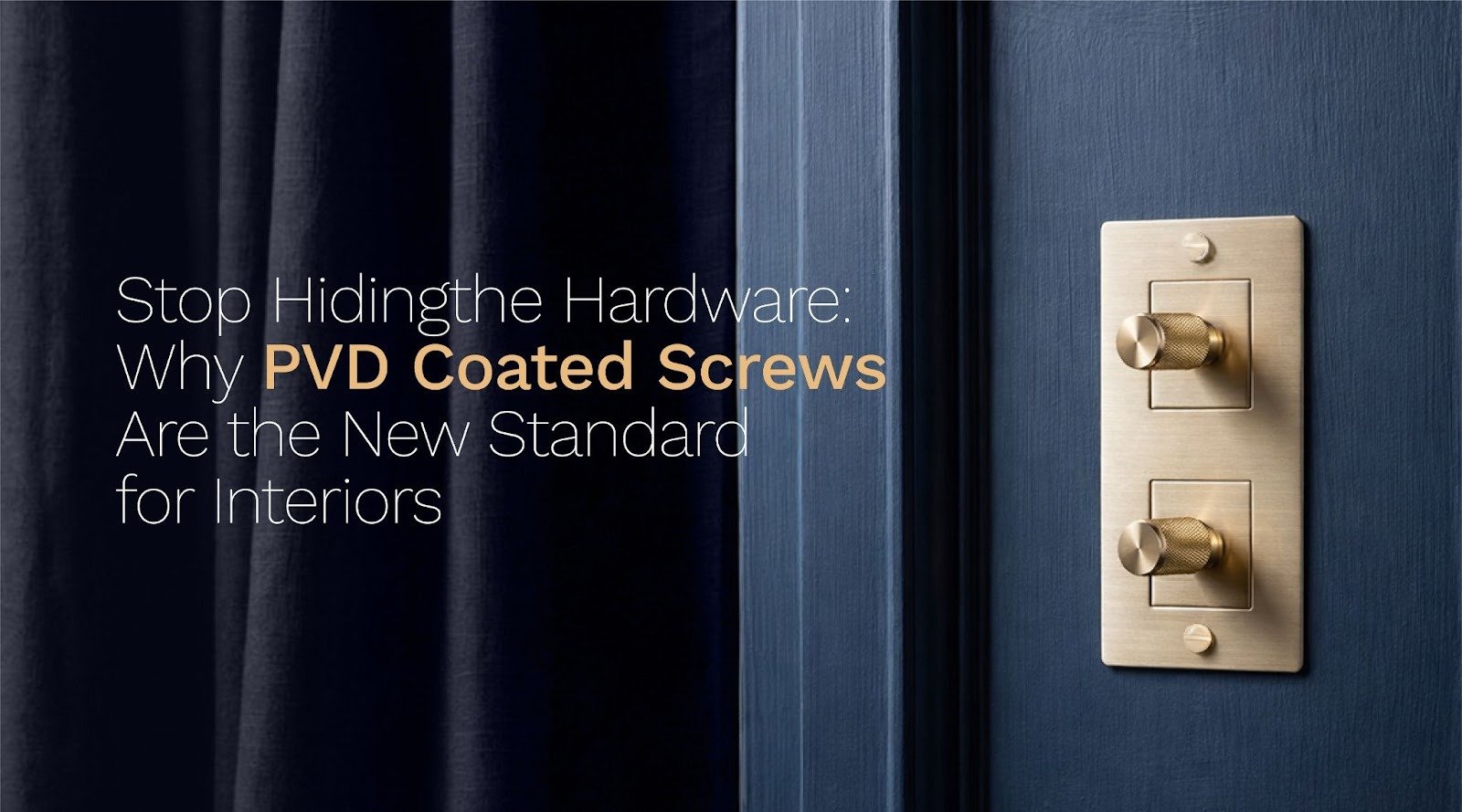
For a really long time, the very screw that enabled the creation of furniture, was often looked at as a barrier in aesthetics by designers. Imagine when a DIY enthusiast or a professional woodworker spends weeks building a signature furniture piece. He selects a deep, charcoal grey laminate for the wardrobes. A beautiful piece of reclaimed Teak wood gets sourced for the main door. And when the craftsman finishes the job, you see a trail of shiny, silver dots marching across your carefully chosen dark surfaces. In an instant, the visual flow is broken. The immersion is lost.
For years, the industry’s response to this ‘Silver Spot’ problem was not to fix the hardware, but to hide it. Carpenters used plastic caps that inevitably popped off and gathered dust. They also tried using adhesive stickers that peeled away in the humidity. A few creative ones even mixed sawdust and putty to fill the holes, only to watch that filler crack and fall out a year later. LP Screw imagined things differently.
But as we move deeper into 2026, the mindset in Indian architecture is shifting. We are witnessing a move away from ‘concealed joints’ towards ‘perfectly complemented joints’. Architects are no longer asking carpenters to hide the screw. They are asking them to feature it.
This shift is largely possible because of the emergence of PVD coated screws in modern design. It has turned a functional necessity into a pivotal design accessory, allowing the fastener to finally catch up with the furniture.
It Is Not Paint. It Is Science.
When designers hear the word ‘coloured screws’, their first instinct is a doubt.
“Is this just a painted screw? “
“Will it chip?”
Well, it is a valid concern. We have all seen low-quality black screws where the paint flakes off the moment the screwdriver bit engages, leaving a messy, jagged head that looks worse than the original silver.
This is where the distinction of a true PVD Screw manufacturer becomes critical. PVD (Physical Vapor Deposition) is not a layer of paint that sits on top of the metal. It is a high-tech vacuum coating process, originally developed for aerospace and medical devices, that bonds the colour to the stainless steel at a molecular level.
The end result is a finish that is incredibly hard and thin. These screws can withstand the high torque of installation without chipping, cracking or peeling. These fasteners can remain as pristine as the laminate it holds.
A Palette for Every Mood
When you are designing a specific project, it is no longer about just ‘black or silver’. It is about finding the exact tonal match for a specific mood. At LP Screw, the philosophy has always been that a fastener should be a deliberate choice. Here is how the palette is being utilized by top designers to enhance specific architectural narratives.
1. The Heritage Narrative:
In India, we consistently prefer the warm, natural feel of materials like Teak, Walnut and Rosewood.
A standard silver hardware clashes with these warm tones. It feels cold and industrial against the richness of the wood. This is where the Antique Bronze pairs up perfectly. It is earthy, understated and disappears beautifully into the grain of dark walnut or stained oak. It respects the timber.
The Luxury Bridge:
For projects that lean towards opulence, Rose Gold acts as a sophisticated bridge. It pairs exceptionally well with copper accents or pink-hued fabrics. Meanwhile, Gold is the boldest choice. When a designer specifies polished brass door handles or gold-finished hinges, using a matching Gold PVD screw creates a sense of ‘uniformity’. It signals to the viewer that this is a premium piece where even the smallest details were coordinated.
2. The Industrial Minimalist
Clean lines, concrete textures and matte finishes are the features of modern minimalism. Absence of clutter is another key feature of this style.
Thus, a shiny silver screw can cause a visual distraction in a kitchen with charcoal laminates and matte black handles. In such settings, Matte Black shade can offer a ‘stealth finish’ while blending perfectly into dark joints. Additionally, Grey shade can serve as a standard neutral for lighter laminates.
Another intriguing shade for the modern designs is Zirconium. This deep metallic hue captures the essence of raw steel, graphite and gunmetal. It can complement well with exposed concrete walls, open-ceiling offices and industrial shelving units.
3. The Avant-Garde
While blending in smoothly is appreciated, a few designs demand boldness, they are meant to shout.
In settings such as a creative studio, bespoke cafe or children’s furniture, designers often choose Rainbow (Neo-Chrome) and Royal Blue shades from LP’s PVD finish range. These shades pop visually, highlighting the details. We are seeing this used effectively in boutique retail spaces where the furniture is part of the art.
Why Durability is a Design Feature
Aesthetics are the hook, but performance is the anchor. In the world of high-end interiors, function must come first. The most significant advantage of PVD coated screws in modern design is longevity. Imagine a high-traffic area like a kitchen drawer channel, a wardrobe hinge, or a door stopper. These are touchpoints that are cleaned daily.
A painted screw will show silver scratches after a few months of cleaning and abrasion. It will fade under the assault of household chemicals. A PVD screw, however, retains its depth of colour.
The Psychology of Detail
Walt Disney once said, “There is no magic in magic. It’s all in detail”. Clients today are well read and very clear on what they want. And to help them achieve the level of the details they are desiring, you can choose the PVD screws for premium projects.
The Manufacturer’s Responsibility
As the demand for coloured hardware grows, so does the influx of cheap imitations. There is a vast difference between a ‘coloured screw’ and a ‘PVD screw’. Cheap imports can never match the specifications of LP’s PVD finish screws. They use a thin lacquer or low-grade electroplating that mimics the look of PVD. But these cheap alternatives fail in scratch tests. As a responsible PVD Screw manufacturer, the focus must be on consistency and in controlling the coating thickness. This is what makes a PVD finish screw as strong as it is beautiful.
The New Standard
The era of the ‘Silver Spot’ is ending. We are entering a phase of Indian design where materials are celebrated. We no longer need to hide the screws behind stickers and putty. With the right palette, from the deep stealth of Zirconium to the warmth of Antique Bronze, we can let the hardware show.
The inclusion of PVD coated screws in modern design is not just a trend. It can be seen as a course correction. It is the final step in ensuring that the engineering of our furniture is as elegant as the design itself.
Refresh Date: February 2, 2026