

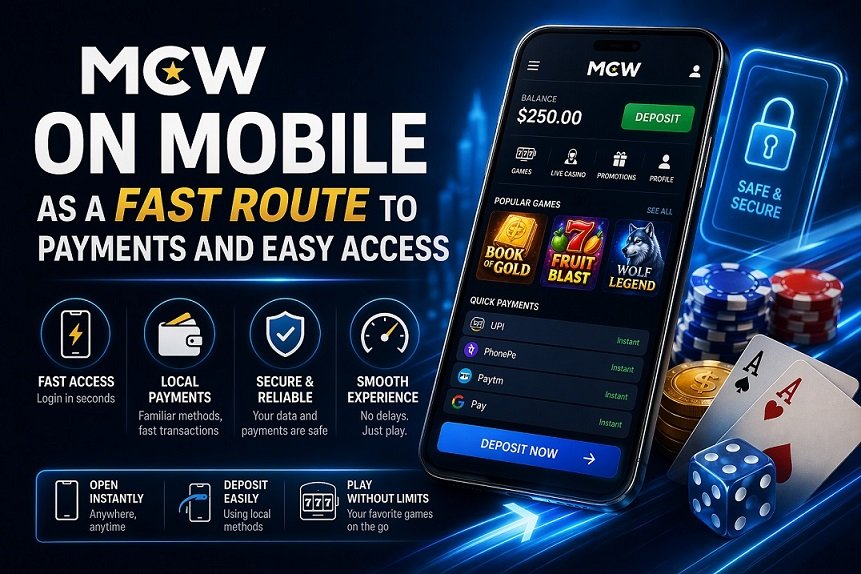
The mobile format in online casinos has long stopped being a backup option for those moments when a laptop is out of reach. For many players, the phone has become the main device through which the entire journey unfolds, from logging into an account to topping up the balance, choosing a game, and tracking payouts. That is why any discussion of MCW on a smartphone comes down not to the look of the interface, but to how quickly the platform guides users through the actions they perform most often and removes unnecessary steps, pauses, and awkward transitions along the way.
Why the Mobile Format Has Become the Main Option for Everyday Play
Players increasingly judge a platform not by the number of sections on the homepage, but by how convenient it is to use in the normal rhythm of the day. On a phone, people are more likely to log in for short sessions, check their balance quickly, open the cashier instantly, and avoid wasting time on lengthy authorization or searching for the right section. That is exactly why the mobile format is no longer just an addition to the main version, but a standalone point of entry where interface responsiveness and ease of navigation directly shape the overall impression of the service.
For MCW, this logic is especially important, because the connection between login, the personal account area, and payment actions needs to work as a single uninterrupted route. When a platform is built around smartphone use, the user expects not just an adapted visual layout, but a complete mobile environment in which actions can be completed from the very first tap. In practice, this means convenient account access, quick movement between sections, and no unnecessary loading delays at the moments when decisions need to be made immediately rather than after several repeated attempts.
How Local Payments Speed Up the Path from Login to Play
One of the main reasons the mobile version can feel genuinely convenient is tied not only to the interface, but also to payment logic. If a platform supports payment methods that are already familiar to its audience, users do not have to adapt to an unfamiliar system, figure out unusual steps, or lose time on extra confirmations. In MCW’s case, the focus on local payments makes the mobile format more practical, because transactions feel closer to everyday financial habits and therefore seem calmer and faster.
Against this backdrop, mobile access through mcw apps looks especially relevant, because the idea of an app or simplified phone login works best when authorization and payment functions are connected without unnecessary interruptions. What users value is not a separate download button or the formal ability to open an account from a smartphone, but the fact that after logging in they can move almost immediately to a deposit and do not have to spend extra minutes repeating actions that feel especially irritating in a mobile environment.
If we look at the issue more broadly, the convenience of local payments in mobile play is built on several simple things that users notice almost immediately:
- a fast transition from login to the cashier
- a clear choice of familiar payment methods
- fewer errors when entering data
- a more natural experience with local currency
It is this practical side that makes the mobile service stronger, because people judge a platform not by its promises, but by how quickly it gets them to the result they want without unnecessary hassle.
App Access as a Tool for Speed and Stable Entry
When it comes to mobile play, access becomes no less important than the payments themselves. Users do not want to search for the current address every time, repeat the same route again and again, or lose a session after accidentally switching between windows. In that situation, app access is perceived not as a decorative feature, but as a way to shorten the distance between the intention to open the platform and the actual start of play. The shorter that path becomes, the more stable the entire service feels and the more trust it builds in everyday use.
This approach also has another important advantage that is often underestimated. A mobile app or a specially designed phone login makes the whole rhythm of interaction noticeably calmer, because the user depends less on random browser interruptions, long returns to the homepage, and constant searching for a working route. As a result, MCW on mobile looks not like a reduced copy of the desktop version, but like a separate usage format where every function is built around one goal: getting the player to the action they need faster without making the process more complicated along the way.
For this reason, the advantage of mobile access shows itself most clearly not in advertising promises, but in everyday details that shape the overall impression of the platform. If login takes less time, the cashier opens without extra transitions, and familiar payment methods fit naturally into the interface, the service feels organized and mature. For the player, that means the phone stops being a compromise and becomes a fully practical tool through which it is convenient not only to access an account, but also to handle all key tasks without losing momentum.
Why This Mobile Model Looks Like the Most Convenient One
The strength of MCW on mobile is revealed not in one isolated function, but in the combination of several solutions that work together and reinforce one another. Fast access, local payments, and a clear route within the mobile environment create exactly the format people now expect from a modern online casino. Users do not come for a complicated interface or a chain of unnecessary actions, but for speed, clarity, and a sense of control, which is why a mobile model built around convenience and the rhythm of everyday use looks the most convincing.
Refresh Date: April 22, 2026