
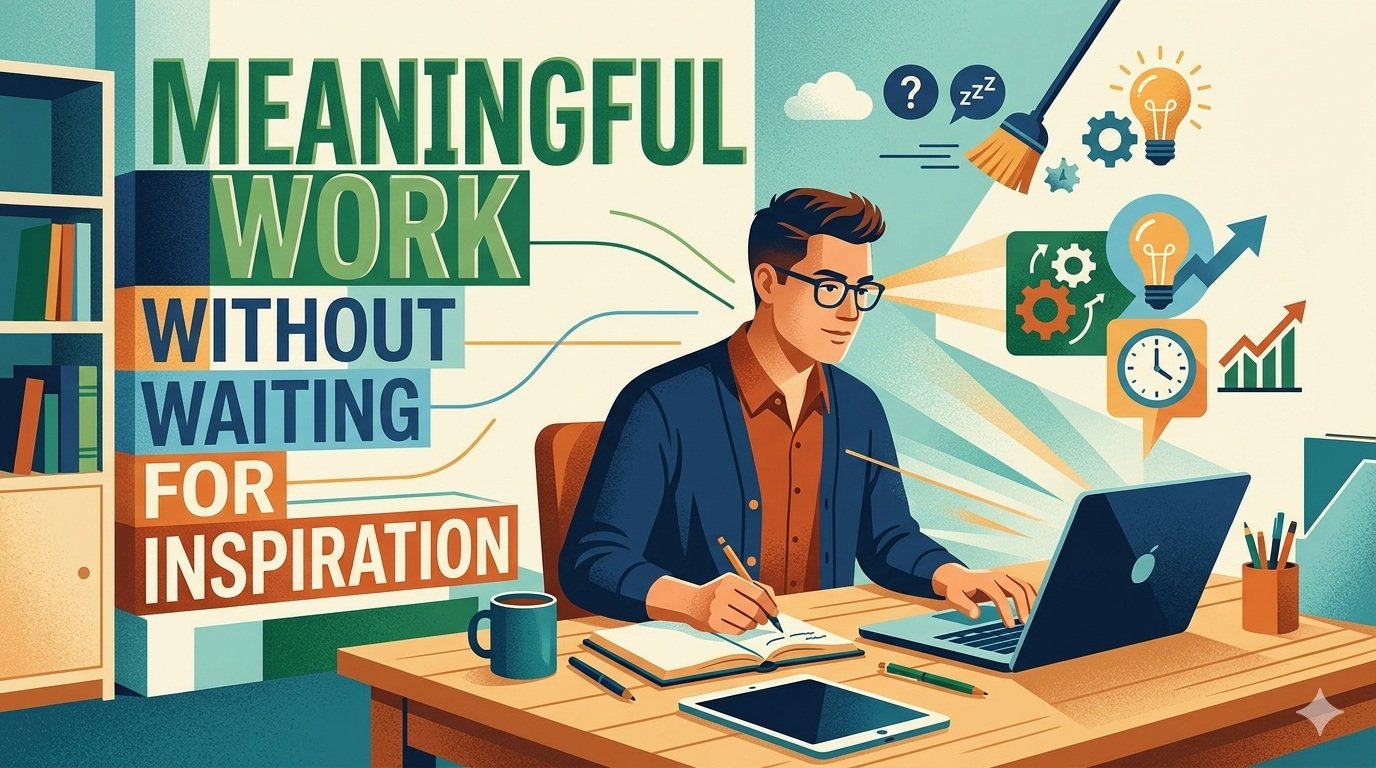
Inspiration Is a Terrible Boss
Inspiration has a great reputation and terrible work ethic.
It shows up late, disappears early, and refuses to follow a schedule. People still treat it like a manager instead of what it actually is: a bonus.
Waiting for inspiration sounds romantic. It also kills output.
A study published in Psychology of Aesthetics, Creativity, and the Arts found that creators who relied on routine and structured practice produced more work and rated it as more meaningful over time than those who waited for inspiration spikes. The gap wasn’t small. Consistent creators simply made more things, which increased the odds of producing something that mattered.
That’s the part people ignore.
You don’t find meaningful work first. You produce volume, then meaning emerges from it.
The Myth of the Perfect Idea
People stall because they think meaningful work starts with a perfect idea.
It doesn’t.
It starts with something small, usually half-formed, often a little awkward. The first version rarely feels important. It feels like a draft. That’s the point.
One writer described sitting down every morning at 7 a.m. with no plan except to fill five pages. Most days felt useless. On day forty-two, a paragraph from one of those sessions turned into a published essay that reached hundreds of thousands of readers.
“I didn’t feel inspired that day,” she said. “I was mostly annoyed I had to wake up early.”
That’s how this usually works.
Meaning shows up after repetition, not before it.
Discipline Builds the Pipeline
Discipline is not about intensity. It’s about repeatability.
If you only create when you feel ready, your output depends on your mood. Mood is unreliable.
If you create on a schedule, output becomes predictable. Predictable output leads to more attempts. More attempts increase the chance of something landing.
A report from the National Endowment for the Arts found that artists who maintained a consistent weekly practice were significantly more likely to complete long-term projects than those who worked in bursts. Completion rate matters more than raw talent.
Most people have ideas. Few finish.
One producer explained his system like this: “I open the same project file every day at noon. I don’t care if I’m tired. I don’t care if I hate the track. I work on it for ninety minutes. Some days I delete everything. Some days I keep one sound. That’s enough.”
That approach looks boring. It works.
Small Wins Beat Big Breakthroughs
Waiting for inspiration trains you to chase breakthroughs.
Discipline trains you to stack small wins.
Small wins compound. They build confidence. They reduce friction. They make starting easier the next time.
Breakthroughs are unpredictable. You can’t plan them.
You can plan showing up.
A designer shared a story about rebuilding her portfolio after losing clients. She committed to posting one new piece every weekday for three months. Most of the work felt average. Around week seven, one post caught attention and brought in three new clients.
“I didn’t plan the good one,” she said. “I just kept shipping until something clicked.”
That’s the strategy.
Constraints Make Work Better
Inspiration loves freedom. Discipline uses constraints.
Constraints remove decision fatigue. They force action.
Time limits, format limits, and topic limits all help. They reduce the number of choices you need to make before starting.
A musician once gave himself a rule: write one song every day using only a guitar and a phone recorder. No studio. No editing. No second takes.
After a month, he had thirty songs. Three made it onto an album. One became a fan favorite.
“I didn’t overthink anything,” he said. “I hit record and dealt with whatever came out.”
Constraints speed up output. Speed increases volume. Volume increases quality over time.
Meaning Comes From Patterns
Meaningful work often looks obvious in hindsight.
At the time, it feels scattered.
You create a series of pieces without seeing the connection. Later, patterns emerge. Themes repeat. Ideas evolve.
That’s where meaning lives.
Research on creative careers shows that people often identify their most important work after it’s already been produced. The significance becomes clear once patterns are visible.
One filmmaker described reviewing years of footage and noticing the same theme showing up in different projects. “I thought I was experimenting,” he said. “Turns out I was circling the same question the whole time.”
You can’t see that pattern if you only create when inspired.
You need volume to reveal it.
Momentum Beats Motivation
Motivation is fragile.
Momentum is durable.
Once you start a habit, continuing it requires less effort than starting from zero each time. That’s why consistency matters more than intensity.
A survey by Creative Boom found that 63% of creatives struggle most with starting, not finishing. The hardest part is getting into motion.
Discipline solves that problem.
One developer turned musician described his rule: “I never skip two days in a row. I can miss one day. Life happens. But I don’t let it turn into a gap.”
That rule kept him producing for years.
Momentum builds identity. You stop thinking of yourself as someone who wants to create and start acting like someone who does.
Separating Output From Judgment
Waiting for inspiration often hides a deeper issue: fear of bad work.
People delay starting because they don’t want to produce something weak.
Discipline separates creation from evaluation.
You create first. You judge later.
That separation increases output and reduces anxiety. You give yourself permission to make something imperfect, which makes starting easier.
One photographer described shooting 500 images in a weekend with no intention of sharing most of them. “I needed to get the bad shots out of my system,” he said. “Once I stopped caring, the good ones showed up.”
That mindset unlocks consistency.
Real-World Example of Staying Productive
Michael Franti built his career on steady output rather than waiting for perfect moments. Touring schedules, recording sessions, and writing routines forced consistency.
One story from early touring stands out. After a long drive, he showed up exhausted before a small venue set. The crowd was thin. The energy was low. He still played like it mattered.
“Halfway through, one guy in the front row started singing every word,” he said. “That reminded me why I wrote the songs in the first place.”
That moment didn’t require inspiration. It required showing up.
Meaning often reveals itself during the work, not before it.
A Better System for Meaningful Work
If you want to create meaningful work, stop waiting for a signal.
Build a system instead.
Pick a schedule. Keep it simple. Remove decisions. Start before you feel ready. Finish more than you start. Review patterns over time.
Meaning is a byproduct of action.
Inspiration still matters. It just shouldn’t be in charge.
Treat it like a surprise guest, not a boss.
Show up anyway.
Also Reads: What Makes a Dining Spot Feel Worth Travelling For
Refresh Date: May 21, 2026