
Amazon Web Services (AWS) and Microsoft Azure are two of the top cloud service providers, offering a wide range of services, a global infrastructure, and ongoing innovation. With the growing trend of businesses shifting to cloud-based operations, selecting the appropriate platform has become a pivotal decision impacting performance, security, scalability, and future costs. The Droven IO AWS vs Azure comparison is all the rage because companies are looking for some real-world advice and not just a comparison of service lists. The detailed comparison assesses the strengths and differences between AWS and Azure, along with their pricing models and best use cases, thereby assisting businesses in making informed decisions about the cloud.
Droven io aws vs azure comparison
Amazon Web Services and Microsoft Azure are the largest public cloud platforms in the market. AWS, founded by Amazon in 2006, was the original company to bring cloud computing to the forefront of the industry and the on-demand infrastructure services to businesses. AWS over the years has built a huge ecosystem of computing, storage, networking, databases, analytics, AI and security solutions. It is very popular in the start-up, developer and technology sectors due to its flexibility and the range of services that it provides. Microsoft Azure has been in the cloud business since 2010 and soon became a big player.
The broad support of Azure integration with Microsoft products like Windows Server, SQL Server, Active Directory, and Microsoft 365 has made Azure popular. It is a full suite of cloud services, but also boasts strong enterprise support, and hybrid cloud capabilities are excellent. Both AWS and Azure are currently supporting millions of customers across the globe and are focused on investment in the innovation and global infrastructure.
Why making comparison matters?
Deciding on which platform to choose—AWS or Azure—is one of the biggest choices a business has to make when it comes to technology. The chosen cloud platform affects the costs, performance, security levels, compliance regulations, and potential scalability of an application. Cloud migration can be a substantial undertaking, so it’s critical for businesses to consider which provider is best suited to their current infrastructure, technical skills, and future goals.
The AWS vs Azure comparison is significant since each cloud service provider has its own set of advantages. Both AWS and Azure have a wealth of service options, as well as deep customization and developer support, and Azure integrates tightly with Microsoft technologies and has exceptional hybrid cloud capabilities. Knowing the distinction between these platforms will help businesses choose the platform that meets their needs, saves money, and optimizes their operations.
Droven.io AWS vs Azure Global Infrastructure Comparison
| Infrastructure Feature | AWS | Azure |
| Global Regions | Extensive coverage | Extensive coverage |
| Availability Zones | Multiple per region | Multiple regions worldwide |
| Data Centers | Large global network | Strong enterprise coverage |
| Disaster Recovery | Strong | Strong |
| Global Reach | Excellent | Excellent |
Droven io AWS vs Azure Compute Services Comparison
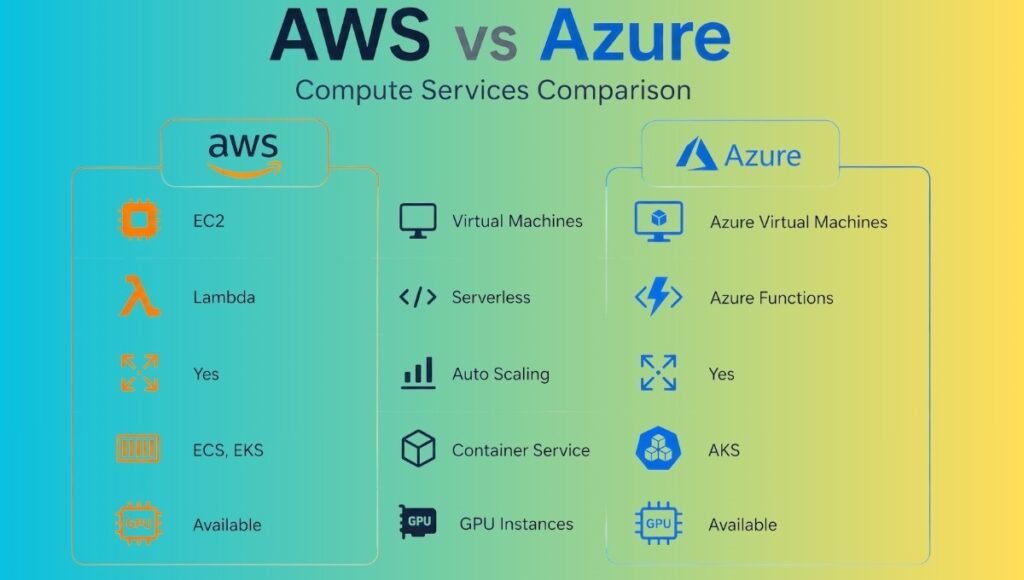
| Compute Service | AWS | Azure |
| Virtual Machines | EC2 | Azure Virtual Machines |
| Serverless | Lambda | Azure Functions |
| Auto Scaling | Yes | Yes |
| Container Service | ECS, EKS | AKS |
| GPU Instances | Available | Available |
Storage Services Comparison
| Storage Feature | AWS | Azure |
| Object Storage | Amazon S3 | Blob Storage |
| Block Storage | EBS | Managed Disks |
| File Storage | FSx | Azure Files |
| Archive Storage | Glacier | Archive Storage |
| Scalability | Excellent | Excellent |
Database Services Comparison
AWS
- Provides a greater choice of managed database services.
- Multiple relational database engines are supported by RDS.
- DynamoDB provides fast and scalable NoSQL storage.
- Redshift is designed for imposing large-scale data warehousing.
- Fully supports postgresql and mysql databases.
- Ideal for cloud-based and flexible deployments of the database.
Azure
- Delivers database management services for an enterprise.
- Azure SQL has strong integration with Microsoft products.
- Cosmos DB provides globally-distributed NoSQL databases.
- Synapse is a hybrid of analytics and warehouse.
- Supports database services (PostgreSQL and MySQL).
- Ideal for Microsoft Business Environments.
Networking Comparison
AWS
- Advanced virtual network customization is available with VPC.
- Route 53 provides extremely reliable DNS service.
- Direct Connect provides private connections.
- CloudFront enhances the delivery of global content.
- Supports enterprise networking architectures.Implements complex enterprise networking architectures.
- Can be deployed on a large scale in the world.
Azure
- The Virtual Network provides easy network configuration.
- Azure DNS seamlessly integrates with cloud services.
- Private connections are possible with ExpressRoute.
- Front Door speeds up the delivery of applications globally.
- Provides strong enterprise networking capabilities.
- Great for Microsoft infrastructure environments.
Security Comparison
AWS
- IAM provides comprehensive identity and access control.
- Protection is achieved via GuardDuty’s intelligent monitoring.
- Secure management of encryption keys is implemented in KMS.
- Security Hub unifies security management.
- Widely provides certification to compliance standards.
- Ideal for highly secure cloud environments.
Azure
- Azure AD is a service for managing identity and authentication.
- Defender includes enhanced threat protection capabilities.
- Key Vault safeguards secrets and encryption keys.
- Sentinel provides a centralized security monitoring solution.
- Has a comprehensive industry compliance certification.
- Proficiently integrates with Microsoft security products.
Hybrid Cloud Comparison
AWS
- Outposts is a service that brings AWS services to the perimeter.
- Provides strong hybrid cloud capabilities.
- Effectively supports local deployment environments.
- Provides dependable enterprise infrastructure services.
- Provides flexible hybrid cloud solutions.
- Best for cloud-first organizations.
Azure
- Azure Arc provides hybrid and multi-cloud resource management.
- Excellent Integration with Windows Server.
- Supports robust on premise deployments.
- Provides best-in-class enterprise hybrid solutions.
- One of the most popular for big companies.
- Perfect for Microsoft powered businesses.
Developer Experience Comparison
AWS
- Supports a wide range of services.
- Provides wide-ranging certification initiatives throughout the world.
- Supports powerful DevOps workflows.
- Provides flexibility in development environments.
- Lots of developers in the community.
- Suitable for experienced cloud developers.
Azure
- Makes it easier to onboard Microsoft users.
- Easily integrates with GitHub services.
- Integrates easily with Visual Studio.
- Provides a more simple learning experience.
- Enables enterprise development processes.
- Ideal for Microsoft developers and teams.
Performance Comparison
AWS
- Delivers excellent uptime across services.
- Delivers scalable infrastructure around the world.
- Supports excellent worldwide network performance.
- Provides adequate cloud service availability.
- Makes best use of challenging workloads.
- Good for use in high performance applications.
Azure
- Excellent worldwide service availability.
- Supports scalable enterprise cloud workloads.
- Performs well on a worldwide basis.
- Implements good reliability control.
- Works well with business applications.
- Appropriate for business production environments.
droven.io AWS vs Azure Pricing Comparison
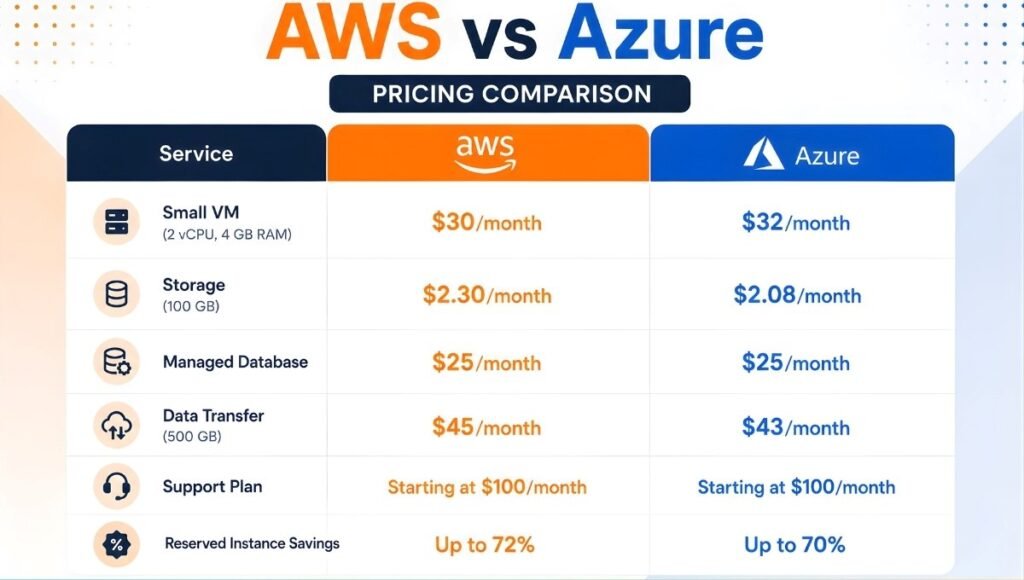
| Service | AWS | Azure |
| Small VM (2 vCPU, 4 GB RAM) | $30/month | $32/month |
| Storage (100 GB) | $2.30/month | $2.08/month |
| Managed Database | $25/month | $25/month |
| Data Transfer (500 GB) | $45/month | $43/month |
| Support Plan | Starting at $100/month | Starting at $100/month |
| Reserved Instance Savings | Up to 72% | Up to 70% |
Comparison of the best Use Cases
AWS
- Best suited for startups and developers.
- Great for cloud-based applications.
- Tended to for contemporary application development.
- Perfect for big web sites.
- Excellent innovativeness for projects.
- Suitable for rapidly growing businesses.
Azure
- Ideal for enterprise-sized companies.
- Great for Microsoft based organisations.
- Ideal for hybrid cloud deployments.
- Perfect for corporate IT solutions.
- Good option to take for enterprise transformation.
- Ideal for businesses that operate on Windows.
Who Should Pick AWS?
- For startups that require flexibility and scalability of cloud infrastructure.
- Builders of cloud-based applications and contemporary software.
- Companies that need a variety of cloud services and tools.
- Companies with container, Kubernetes and DevOps workflow adoption.
- Businesses that require sophisticated customizations and network capabilities.
- Technology firms developing AI, machine learning and data-based applications.
Who should Choose Azure?
Microsoft Azure is ideal for the following organizations.
- Businesses with a pre-existing Base of Microsoft products/ services.
- Organizations that operate Windows Server and SQL Server applications.
- Businesses that require strong hybrid cloud capabilities.
- Businesses that leverage Microsoft 365, Active Directory and Visual Studio.
- Large organisations with Microsoft licensing benefits.
- Businesses seeking streamlined operations and hassle-free integration.
Who should choose both AWS and Azure?
- Large companies using multi-cloud.
- Organizations that are seeking to prevent vendor lock-in.
- Cloud environments with different workloads running on multiple cloud platforms.
- Businesses with increased availability needs and disaster recovery needs.
- International organisations with operations in several regions/markets.
- Businesses between expense, efficiency and niche cloud solutions.
Conclusion
Both cloud platforms come equipped with powerful infrastructure, advanced security, scalable services, and modern Artificial Intelligence (AI) features, as demonstrated by the Droven IO AWS vs Azure comparison. AWS continues to be the go-to cloud solution for startups, developers, and businesses that require flexibility and a variety of cloud services. Azure, on the other hand, is best for enterprises that are dependent on Microsoft products and need robust hybrid cloud capabilities.
While there’s no one obvious winner, the best option will depend on your business needs, the current infrastructure, the budget and future plans. AWS would be a better option for companies that are focused on innovation and cloud-native applications, while Azure would be better for companies with Microsoft environments. Many big companies now employ both platforms as a multi-cloud strategy to benefit from the strengths of each provider.
FAQs About Droven io aws vs azure comparison
A1. The pricing is based on the working loads and working schedules. AWS provides flexible pricing plans, whereas Azure might be a better option for businesses that are already using Microsoft licenses.
A2. AWS has a lot of learning resources, but those already using Microsoft products and services might find it easier to use Azure.
A3. The enterprises may prefer Azure due to integration with Microsoft tools, integration with hybrid cloud, and enterprise licensing options.
A4. Yes, it is possible for many organisations to use both AWS and Azure, having a multi-cloud approach can enhance flexibility, reliability and disaster recovery.
A5. Both platforms have a robust AI offering. Advanced machine learning solutions from AWS and great AI solutions that integrate seamlessly with the Microsoft ecosystem from Azure.
Also Read: How to Convert YouTube to MP3 Legally in 2026: Complete Guide for Content Creators
Refresh Date: July 3, 2026