
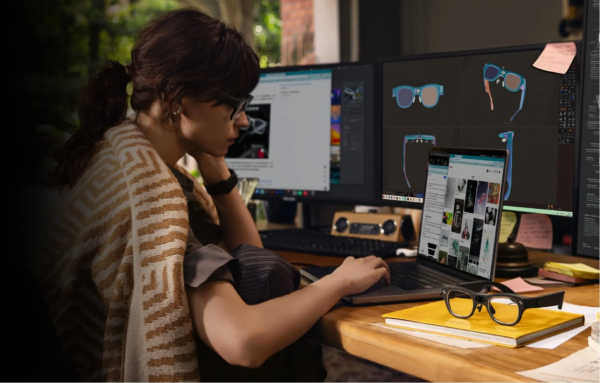
AR glasses for work add a practical digital layer to daily tasks. Instead of switching between laptops, phones, and paper notes, workers can view prompts, instructions, messages, and live information within their field of view. That change reduces interruptions and helps people stay focused on the job in front of them. Offices, warehouses, service teams, and remote staff all benefit from faster access to data and more fluid communication. As companies look for better ways to improve output without increasing complexity, AR glasses are becoming a useful tool for streamlining workflows, supporting collaboration, and helping employees move through tasks with greater speed and accuracy.
AR Glasses as a Productivity Layer
From Single Screens to Multi-Layer Workspaces
Traditional work setups force people to jump between tabs, windows, devices, and physical documents. AR glasses change that by turning the visual field into a multi-layer workspace where relevant information appears when needed. A technician can view instructions while handling equipment, and an office worker can keep calendars, notes, or message alerts visible without covering the main task. This approach reduces context switching, which often slows performance and increases mental fatigue. Instead of relying on a single screen as the center of productivity, ar glasses distribute digital content more naturally around the workflow. The result is a cleaner way to manage tasks, reference information quickly, and keep attention on work that requires immediate action.
Real-Time Data Without Workflow Disruption
Efficiency often drops when workers must stop what they are doing to check a screen, search for information, or ask for clarification. AR glasses solve that problem by delivering real-time data inside the flow of work. Status updates, navigation prompts, checklists, and machine details can appear instantly without forcing users to pause. This matters in roles where timing and accuracy are critical. Instead of breaking concentration, information arrives at the right moment and in the right context. Teams can respond faster, make fewer avoidable mistakes, and spend less time repeating steps. By keeping data accessible but unobtrusive, AR glasses support smoother execution and help workers maintain momentum throughout the day.
Workplace Use Cases of AR Glasses
Remote Work and Digital Multitasking
Remote work often requires people to manage calls, chats, documents, calendars, and shared dashboards at the same time. AR glasses help organize that digital load by making key information available without constant screen toggling. A user can follow a meeting, check notes, and monitor incoming updates while staying engaged in conversation. This creates a more fluid multitasking experience and reduces the friction that comes from juggling windows across devices. AR glasses also support more mobile work, allowing professionals to stay connected while moving between locations or workstations. For distributed teams, that flexibility improves responsiveness and makes everyday coordination feel less fragmented, especially during packed schedules with overlapping priorities.
Field Operations and Hands-Free Access
In field operations, stopping to open a laptop or handle a phone can slow progress and create safety risks. AR glasses provide hands-free access to instructions, inspection steps, equipment records, and task confirmations while work continues. That makes them especially useful for maintenance, logistics, warehousing, and on-site service roles. Workers can verify procedures in real time, document progress faster, and reduce reliance on memory. In practical use, devices such as RayNeo X3 Pro also extend communication on the job. It integrates global AI translation for instant communication, connecting users with an unknown language in 2.1 seconds through on-screen text or synchronized audio. It also starts meeting recording and summarization with “Hey RayNeo” voice activation.

Collaboration and Communication Efficiency
Visual Guidance and Remote Assistance
AR glasses improve collaboration by making support more immediate and visual. Instead of describing a problem over a call or waiting for an expert to arrive, workers can share their viewpoint and receive guidance in context. Instructions can be delivered as overlays, directional markers, or step-by-step prompts aligned with the task at hand. This speeds up troubleshooting, shortens training time, and reduces misunderstandings. Remote assistance becomes more effective because both sides can focus on the same visual reference instead of interpreting verbal descriptions alone. For organizations with distributed teams or specialized equipment, that means faster problem resolution, better knowledge transfer, and less downtime when employees need help to complete technical or unfamiliar work.
AI and Language Support in Work Environments
Communication delays can create bottlenecks, especially in multilingual workplaces or teams spread across regions. AR glasses with AI support reduce those delays by helping users capture speech, translate conversations, and surface useful context during interactions. That allows employees to understand instructions faster, respond with more confidence, and avoid simple errors caused by language gaps. AI tools can also summarize meetings, highlight action items, and turn spoken discussion into searchable text, cutting down on manual note-taking. In customer-facing, operational, and internal team settings, these features make communication more efficient without adding extra devices or software steps. The result is quicker alignment, clearer handoffs, and better continuity across fast-moving work environments.
Conclusion
AR glasses for work improve efficiency by placing information, communication, and guidance closer to the task itself. They reduce screen switching, support hands-free access, and help workers act on real-time data without breaking focus. Across remote work, field operations, and team collaboration, they create faster and more connected workflows. Their value is not limited to convenience; they also improve clarity, responsiveness, and task accuracy. As organizations refine how work gets done, AR glasses are becoming a practical productivity layer rather than a novelty. For teams that need speed, mobility, and better coordination, they offer a clear advantage in everyday operations.
Refresh Date: July 8, 2026